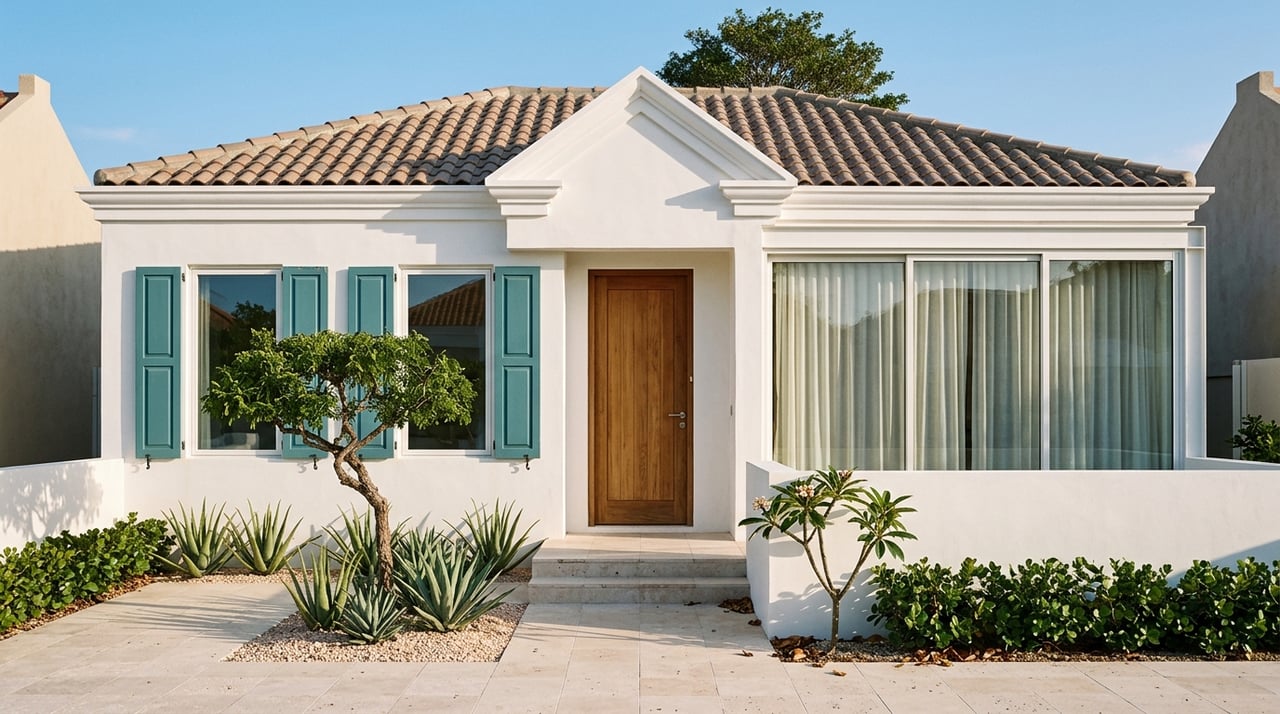
If you are searching for property in Aruba, you will quickly encounter two terms that appear on almost every listing: eigendom and erfpacht. In plain English, freehold (Property land) and leasehold. Understanding the difference between these two types of land ownership is one of the most important things any buyer can do before making an offer. The good news is that it is genuinely not complicated once it is explained clearly.
Freehold/ Property Land - Eigendom
Freehold property is privately owned land where you hold the deed outright. It gives you full control over the property and is the most straightforward form of ownership. When you buy a freehold property in Aruba, you own both the land and everything built on it. You pay no annual ground rent to the government. The land is yours to use, sell, mortgage, or pass on to your heirs without any time limit attached.
Ownership of real estate in Aruba must be recorded in the public register for real estate, and the civil law notary who executes the deed of transfer registers the new ownership accordingly.
Freehold properties tend to be found more commonly in inland and residential areas, Santa Cruz, Paradera, Savaneta, and pockets of Oranjestad. They are typically priced at a modest premium relative to comparable leasehold properties, reflecting the unconditional nature of the ownership.
Leasehold: Erfpacht
Leased land belongs to the government, which assigns a long-term lease, typically 60 years, to the title holder. The leasehold title holder has the right to act as a full owner and may sell, mortgage, or transfer the rights to the land similar to any other property ownership. The title holder pays a yearly fee for the lease rights.
Throughout the lease term, you are entitled to use the land as if it were your own, while respecting the applicable general and special leasehold conditions. The annual fee remains constant throughout the 60-year duration. Upon completion of the initial 60-year term, the lease is extended for another 60 years, at which point there may be an increase in the yearly fee.
Here is the crucial point that surprises many buyers: leasehold does not mean second-class ownership. Many of Aruba's most sought-after locations, Palm Beach, Eagle Beach, and a significant portion of homes in the Noord area, are situated on leasehold land. Popular areas including Malmok, Arashi, Safir, Topaz, Esmeralda, Ruby, Opal, Saliña Cerca, and Tierra del Sol are mostly constructed on leased land. If leasehold were a dealbreaker, the island's most desirable and most expensive properties simply would not exist.
Which is better?
Neither is universally better. The right choice depends on what you are buying, where it is, and what matters most to you.
Buyers often value freehold for stronger long-term control, simpler financing, and typically better marketability at resale. With leasehold, you purchase a long-term right to use and develop the land under a lease, and it can offer a lower purchase price, though marketability depends on remaining term, ground rent level, and renewal clarity.
In practice, the practical differences for most buyers are modest. A leasehold property with 55 years remaining on a 60-year lease, in a prime location, at a strong price, is often a better decision than a freehold property in a less desirable location at the same budget. Our team evaluates every property on its own merits, not just its land type.
What to check before buying leasehold
Before committing to a leasehold property, there are a few things every buyer should verify. How many years remain on the current lease period? What is the annual ground rent fee, and has it been paid consistently? Does the lease allow you to mortgage the property, important if you are financing the purchase? And what are the conditions attached to the lease regarding use, modifications, and transfer?
Ask local banks about their appetite for your specific title and the remaining lease term they require. Confirm the lease allows you to mortgage the leasehold interest. A qualified local attorney or notary can review the full lease document and flag anything that requires attention before you sign.
The bottom line
Both property land and leasehold are valid, legally sound, and widely used forms of property ownership in Aruba. The island's most iconic and valuable properties sit on leasehold land. What matters most is not the land type in isolation, it is the combination of location, price, remaining lease term, annual fees, and how the property fits your goals as a buyer or investor.
At Bold Properties Aruba, we explain land ownership clearly and honestly on every property we present. No surprises. No jargon. Just the information you need to make a confident decision.